Verdictris Beta
Verdictris
A noir courtroom-bluffing strategy game where hidden roles, contested actions, forensic clues, and one decisive vote can change who controls the city.
Verdictris drops you into a living city of secret allegiances and imperfect information. Every character has a hidden role, a personal objective, a profession, unique abilities, and a reason to make the courtroom believe their version of events.
Read the city. Choose who to trust. Collect evidence, protect an ally, sell information, corrupt an investigation, manipulate a vote, or remove a threat before they can expose you.
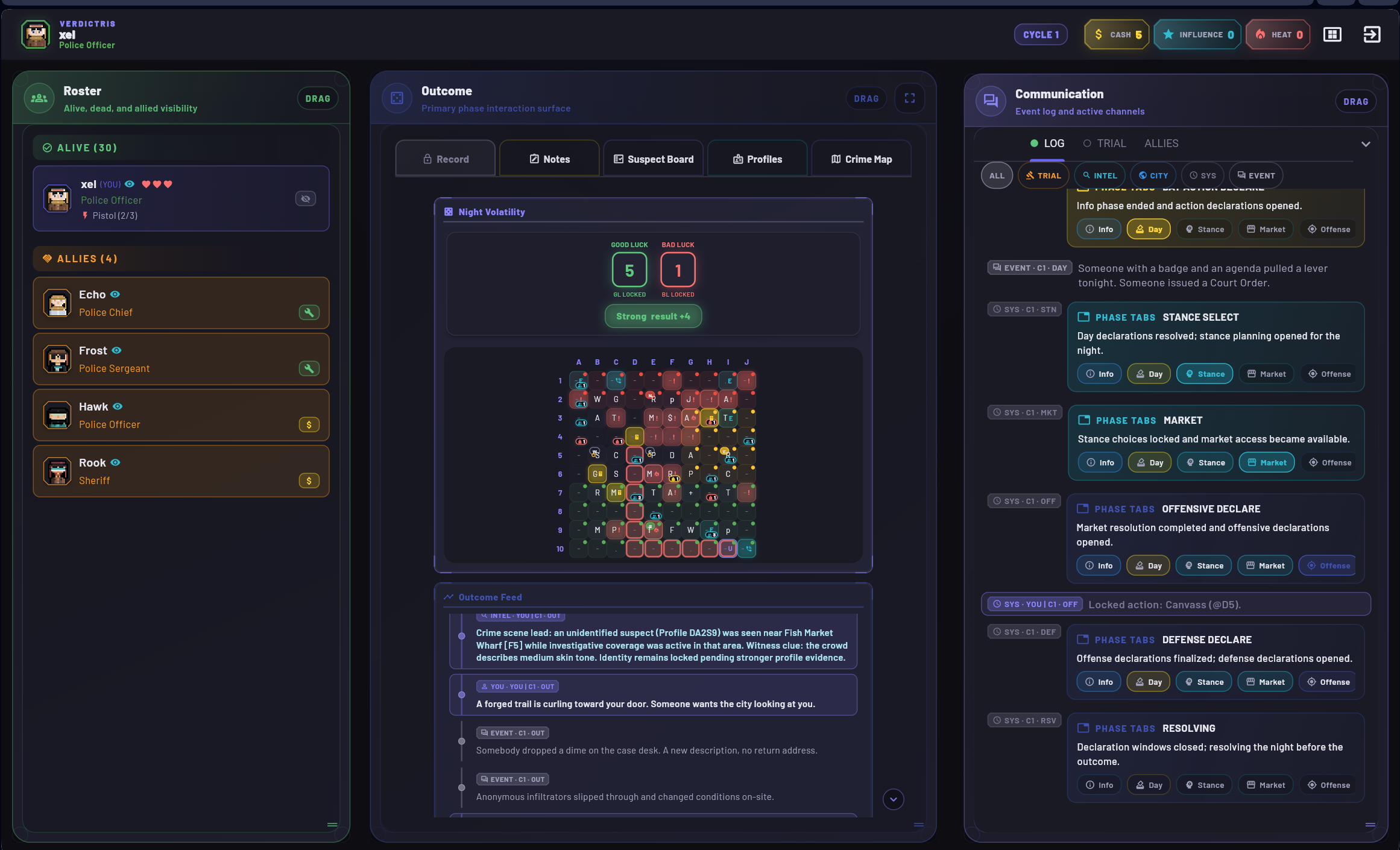
Your actions are tested through 2d6 Good Luck versus Bad Luck contests, where character statistics, equipment, preparation, witnesses, and circumstances can turn the same plan into a clean success, a costly compromise, or a public disaster.
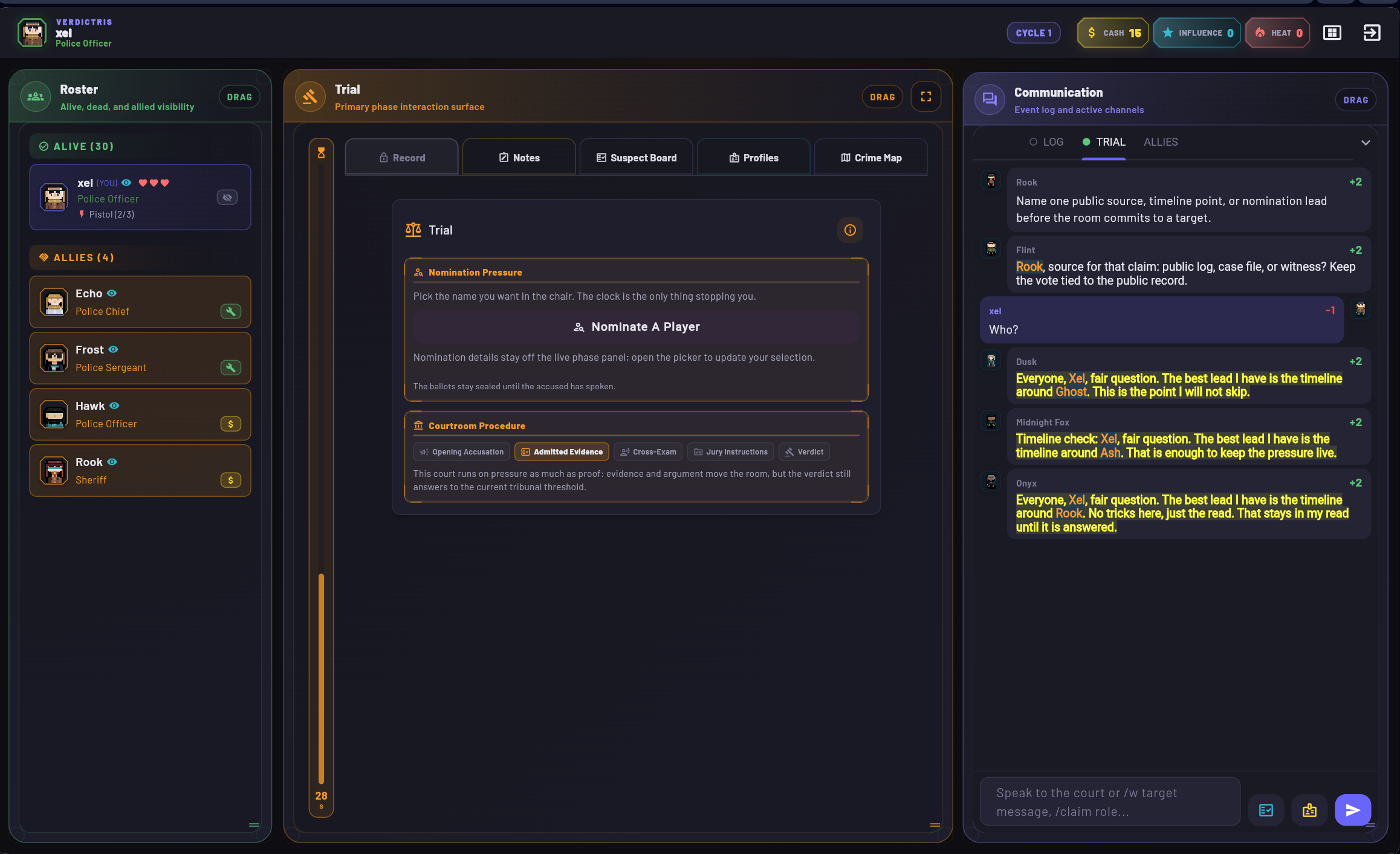
When suspicion reaches the Trial Gate, the case moves into court. Nominate a suspect, present what you know, challenge questionable claims, negotiate a plea, and cast the vote that may acquit, detain, or eliminate a player.
Public facts matter—but so do credibility, timing, and the lies nobody can disprove yet.
Three alignments. Many ways to shape the verdict.
Common Good — Build a case the city can trust
Good roles win by removing the organized threat from active play. That can mean eliminating every Evil actor or neutralizing enough of the criminal faction through arrests, jail, and imprisonment.
The strongest Good strategy is not blind aggression. It is a credible chain of information that survives cross-examination.
Possible Good stories include:
- Investigator: Canvass districts, assemble forensic profiles, and publish evidence strong enough to move a divided jury.
- Police Officer: Detain suspects, make repeated arrests, and pursue a non-lethal victory by taking criminals out of circulation.
- Informant: Tail targets, wiretap conversations, and move intelligence through dead drops without exposing the source.
- Judge: Issue court orders, review cases in chambers, and turn authenticated evidence into warrants and courtroom pressure.
- Mayor or Governor: Build influence, direct civic policy, and hold together a voting bloc while the Underworld tries to fracture it.
- Citizen: Organize a neighborhood watch, feed the tip line, and prove that an ordinary witness can become the center of the case.
Neutral — Survive, bargain, and pursue your own agenda
Neutral roles are not one united team. They lack the coordinated network of Good and Evil, but compensate with independent tools, contracts, leverage, and flexible loyalties.
A Neutral faction victory requires Neutral players to become the last active alignment—and every surviving Neutral must have meaningfully participated. Hiding until everyone else falls is not enough.
Possible Neutral stories include:
- Bounty Hunter: Mark suspects, track their movements, pin down dangerous targets, and complete a sustained hunt instead of chasing one lucky shot.
- Lawyer: Object at the right moment, prepare a cross-examination, suppress weak evidence, visit detainees, or negotiate a plea that changes a guilty sentence.
- Journalist: Follow leads, pressure sources, publish an exposé, and turn private investigation into verified public pressure.
- Medic: Stabilize endangered players, triage suspicious injuries, and use autopsy findings to keep the truth alive longer than its witnesses.
- Body Guard: Intercept attacks, assess threats, establish safe houses, and decide whose survival is worth risking your own.
- Driver: Swap positions, recon routes, stage a getaway, or close the road with a well-timed blockade.
- Spy: Collect evidence, sell information to the highest-value client, or fabricate a trail convincing enough to redirect the investigation.
- Hitman: Remain an unaffiliated freelancer, accept contracts, post private bounty intelligence, and complete a campaign of calculated assassinations without becoming anybody’s true ally.
Evil / Underworld — Control the city through doubt
Evil wins after gaining a strict active majority over Good and neutralizing enough of the city’s key leadership.
Violence is only one route. A quieter syndicate can win by corrupting evidence, protecting its hierarchy, buying information, controlling revenue, and encouraging Good players to destroy their own credibility.
Possible Evil stories include:
- Corrupt Officer: Tamper with evidence, scan an investigation from inside the police structure, plant false clues, and use the badge as camouflage.
- Cleaner: Erase forensic traces, dispose of incriminating assets, frame another suspect, and keep the syndicate’s worst actions out of the courtroom.
- Arsonist: Prepare accelerant caches, ignite property, spread citywide panic, and profit from the disorder.
- Murderer: Sustain fear across multiple cycles with lethal pressure, blackmail, and planted timelines.
- White-Collar Criminal: Bribe, forge, run shell games, and build a fraud network that finances the Underworld without leaving an obvious crime scene.
- Mafia Associate or Soldier: Scout targets, protect allies, enforce rackets, and keep information and cash moving up the organization.
- Mafia Capo, Underboss, or Boss: Coordinate commands, silence witnesses, shield the network, open smuggling routes, buy intelligence, and turn scattered criminals into a disciplined voting machine.
Winning the faction is only half your story
Every role also carries a measurable personal objective.
These objectives do not end the match and do not replace the alignment victory. Instead, the final case report records whether you helped your faction win, whether you completed your own assignment, or whether you salvaged a personal success from a losing side.
Personal objectives may include completing multiple investigations, sustaining civic leadership, surviving while delivering legal impact, executing repeated reroutes, finishing a bounty campaign, protecting clients over several cycles, maintaining criminal revenue, or commanding a long-term syndicate operation.
That creates several different endgame stories:
- Win the case and complete your role objective.
- Help your alignment win but leave your personal assignment unfinished.
- Lose the faction struggle while still completing your individual objective.
- Survive deep into the case but fail because your alignment never achieved its actual victory condition.
- Win without exterminating the opposition by using detention, jail, and imprisonment to remove enough threats from active play.
- As Neutral, outlast both organized factions—but only after proving you participated in the case.
Major features
- 33 hidden role dossiers across Good, Neutral, and Evil alignments.
- 20, 30, or 40-player cases filled with autonomous computer-controlled personalities.
- Single Player, Spectator, and guided Tutorial modes.
- Turn-based information, action, trial, and outcome phases.
- 2d6 contested actions influenced by statistics, stance, equipment, preparation, and circumstances.
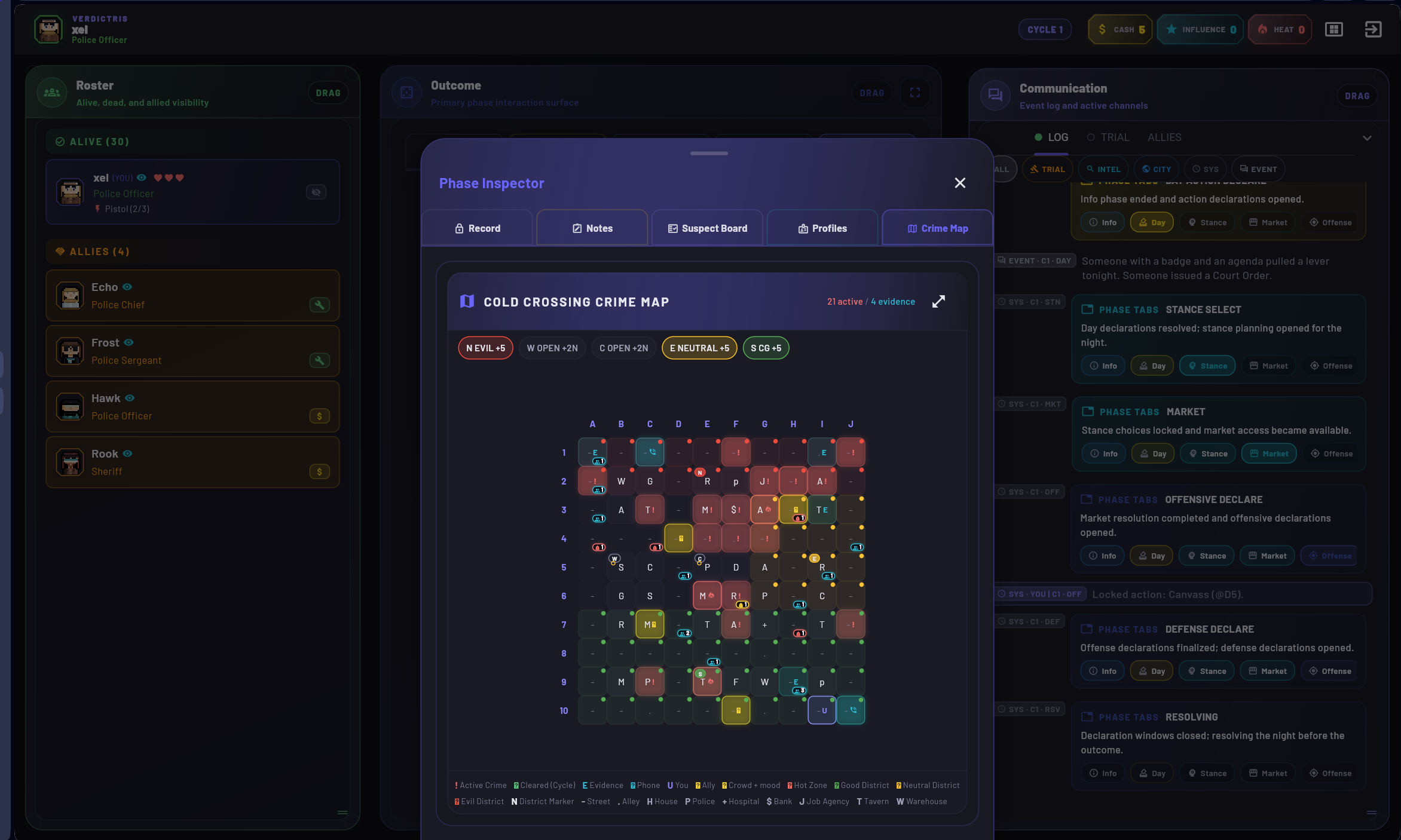
- A living 10×10 crime map with districts, routes, relocation trails, taverns, witnesses, incidents, and forensic pressure.
- Evidence profiles, appearance clues, bystander reports, private intelligence, public records, and deliberate misinformation.
- Courtroom nominations, role claims, objections, pleas, conviction votes, acquittals, detention, and sentencing.
- Black-market weapons and utility items, contracts, cash, influence, professions, faction networks, and personal objectives.
- Configurable presets, Quick Rules, a complete strategy guide, role encyclopedia, and accessibility options.
- Persistent browser-local case history and unranked statistics.
- Touchscreen-friendly controls and responsive layouts.
Offline edition
This browser edition is fully offline after loading.
It contains no accounts, advertisements, analytics, cloud saves, multiplayer calls, or public leaderboard uploads. Your settings, completed cases, and statistics remain in your browser.
Recommended for players who enjoy: social deduction, turn-based strategy, hidden-role games, courtroom drama, dice systems, forensic investigation, political maneuvering, and replayable simulation.